


How an Apparel Order Travels Through Three Companies’ Systems: Where Machines Read and Where People Read
Business systems basics 3/4 · How an Apparel Order Travels Through Three Companies’ Systems: Where Machines Read and Where People Read
KEY POINTS
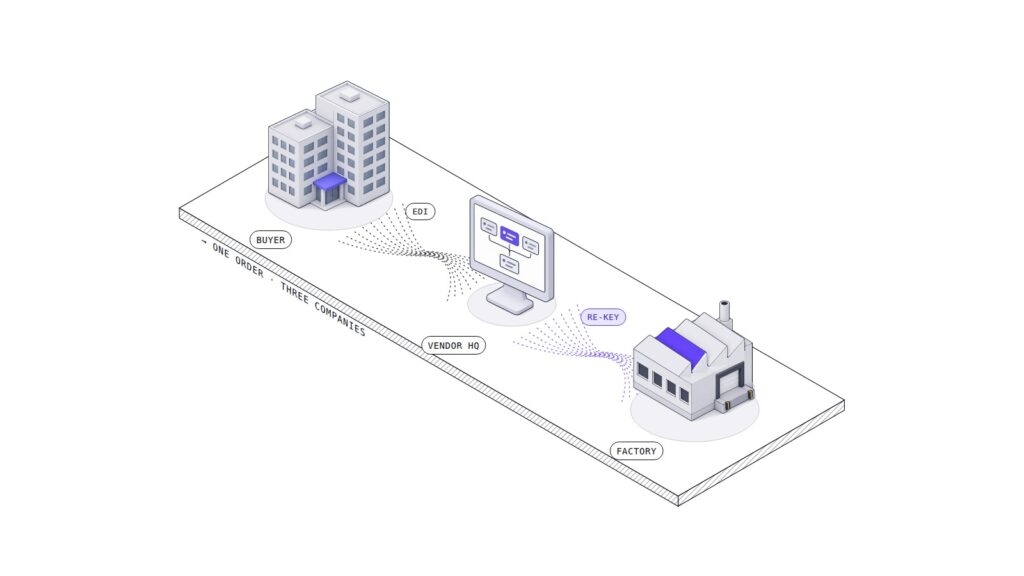
One apparel order passes in turn through the buyer’s PLM, the vendor’s ERP, and the factory’s production plans and output records. There are three ways to connect one company to another: EDI, where systems exchange standard electronic documents; portals, where a person logs into the other company’s system; and PDFs and spreadsheets sent by email. EDI is used mainly for purchase orders, ship notices and invoices between buyer and vendor, while the link between vendor and factory runs mostly on files and email. Each company calls the same order by a different number, the partner to connect with changes from order to order, the side that sets the connection rules is not the side that pays for them, and each company can show a different range of data. For these reasons, connecting companies is much harder than connecting systems inside one company.
Part 1 covered what PLM, ERP, APS, MES and WMS manage, and part 2 covered why these systems grew as five separate branches. Part 2 ended on this point: manufacturing spent decades connecting the systems inside one company, but in apparel those systems are split across three companies, the buyer, the vendor and the factory.
In this post I will follow one order and look at the form information takes when it crosses the boundary between companies. There is one test: can the receiving system read the information directly, or does a person have to read it and type it in again?
Three ways to connect companies
There are three broad ways to exchange information between companies.
System to system: EDI
EDI (Electronic Data Interchange) is a way for companies to exchange electronic documents in an agreed standard format, directly between systems. In the United States the ANSI X12 format is widely used, and each document has a number.1
Think of a standard shipping label used by every courier. Because the layout is fixed, any courier’s machine reads the recipient’s address and the weight from the same fields. EDI works the same way: the purchase order number goes in one field, the quantity in another, so the receiving system reads it without anyone touching it.
| Document | Name | Sent by | Contents |
|---|---|---|---|
| 850 | Purchase order | Buyer → supplier | PO number and date, delivery date, items, quantity, unit and price, shipping and payment terms1 |
| 856 | Advance ship notice (ASN) | Supplier → buyer | PO number, ship date, items and quantities, items per carton, cartons per pallet, carrier2 |
| 810 | Invoice | Supplier → buyer | Invoice details1 |
EDI documents commonly exchanged between buyers and suppliers
A person logs into the other company’s system: portals and PLM
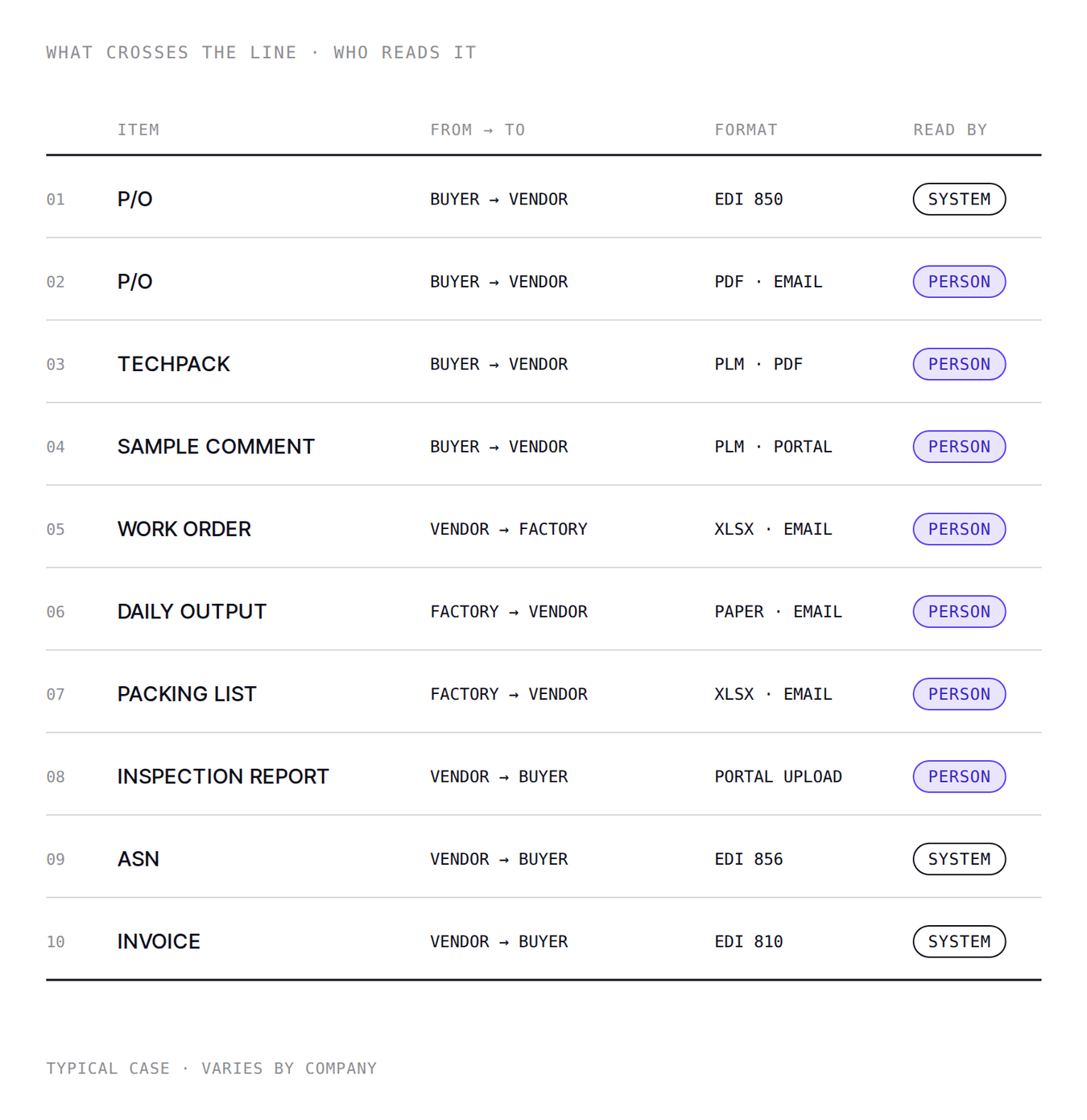
The second way is for vendor staff to log into the PLM or supplier portal that the buyer runs. They download the TechPack, read sample comments and upload inspection reports. The information sits in the buyer’s system, but it is a person who moves it into the vendor’s ERP. The staff member is the link between the two systems.
Files and email
The third way is to send PDFs, spreadsheets, email text, messenger messages and photos. The receiver opens the file, reads it, and enters the values they need into their own system or form. Most of the six handoffs described in Where Information Changes Hands in the Supply Chain Workflow run this way.
| Method | Form that crosses | Who reads it on the receiving side |
|---|---|---|
| EDI | Standard electronic document | System |
| Portal or PLM login | The other system’s screens, downloaded files | Person |
| Files and email | PDF, spreadsheet, email text, photos | Person |
Three ways to connect companies, and who reads the information on the receiving side
Following one order
Now let’s place the three methods on the flow of one order. I will use WJ-2411, the fictional style number from the earlier series.
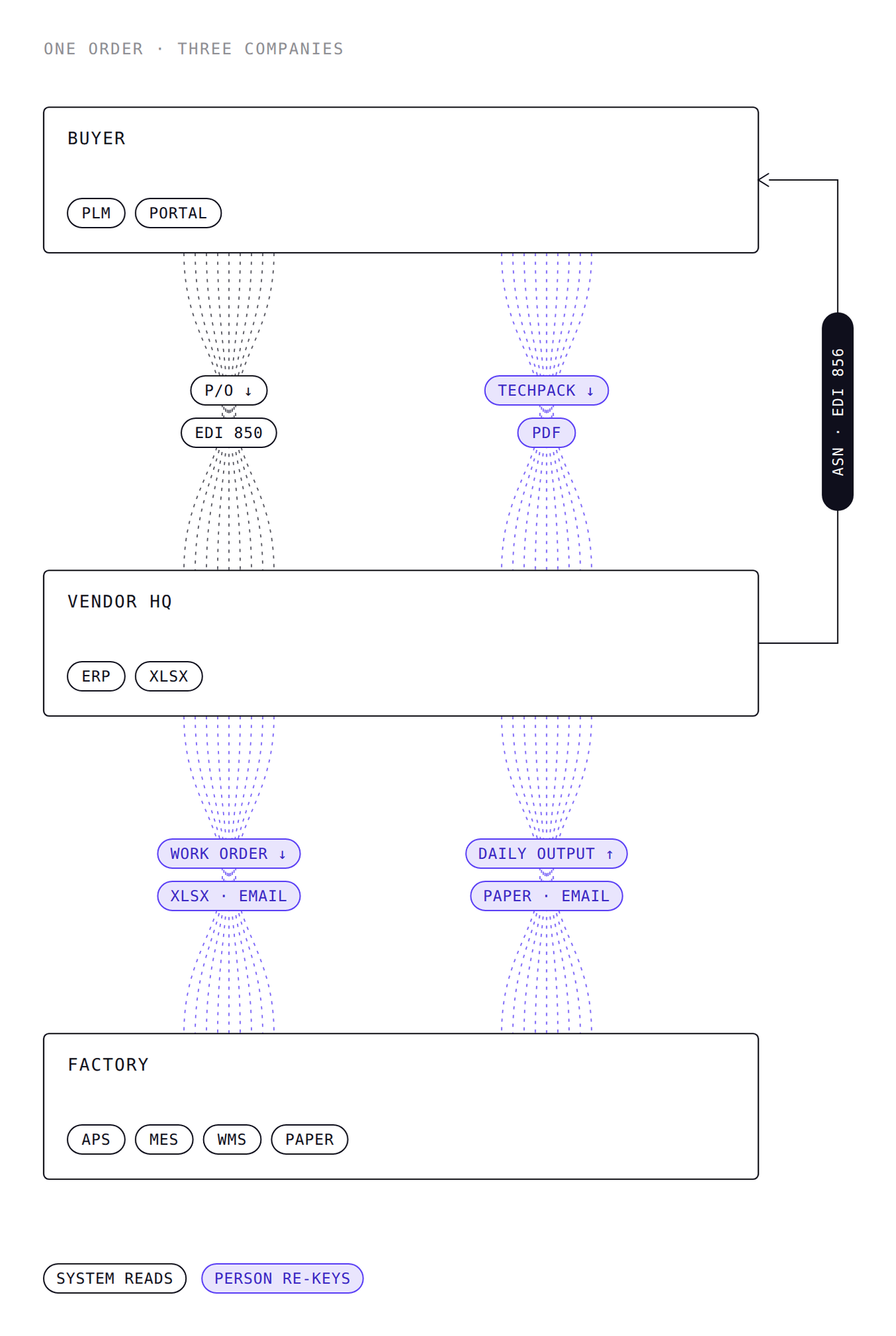
When the buyer places an order, the P/O goes to the vendor. With a buyer that uses EDI, an 850 document lands directly in the vendor’s system; with other buyers, a PDF arrives by email. Even for the same vendor, the method differs by buyer. For specifications, a staff member downloads and reads the TechPack posted in the buyer’s PLM.
At the vendor head office, this information is entered into the ERP as an order, cost and BOM are built, and fabric and trims are ordered. Up to this point everything is inside one company, so it can stay connected within the ERP.
The next step, where the order passes to the factory, is different. The vendor puts the work order, specifications and material arrival dates into a spreadsheet and sends it by email, and the factory reads the file and enters it again into its own production plan, APS or MES. In the other direction, daily output and inspection results from the factory are compiled into daily reports or spreadsheets and emailed to the vendor, where staff copy the numbers back into the ERP or an internal sheet.
At shipment, systems come back into play. The vendor builds the invoice from the packing list the factory sent, and sends the ASN by EDI or through the portal in the form the buyer requires.
In short, order information comes in as something a machine can read, turns into something a person reads, and turns back into something a machine can read just before shipment. At every point where it becomes something a person reads, someone reads a document and enters it again.
Four reasons connecting companies is hard
Inside one company, there is even a standard for connecting ERP and MES. ISA-95, which we saw in part 2, was created to standardize how isolated enterprise systems and floor systems are integrated.3 Between companies, this kind of connection is much harder, for four reasons.
Each company calls the same order by a different number
The buyer refers to an order by its P/O number and style number, the vendor by its internal order number, and the factory by its own job or lot number. Before systems can be connected, there has to be a mapping table showing that these numbers point to the same order. How tricky it is to match each buyer’s P/O layout to an internal format is covered in PO Mapping, Possibilities of AI and the Realities of Coding.
The partner changes from order to order
A vendor works with many buyers and chooses a factory for each order based on line schedules and price. How factories are chosen is covered in When the Lowest Unit Price Is Not the Optimal Factory. For example (an illustration only), a vendor working with three buyers and five factories has to handle three different purchase order formats and five different reporting formats at the same time. When each pair of partners is connected directly, the number of connections grows much faster than the number of partners.4
The side that sets the rules is not the side that pays
EDI between buyer and vendor usually follows a format and deadlines set by the buyer. When a supplier fails to meet these requirements, the retailer deducts a penalty directly from the supplier’s payment, known as a chargeback. Missing the ASN deadline triggers a chargeback in the retailer’s system right away, and wrong carton labels mean the warehouse cannot match cartons to the ASN data.5 The burden of compliance sits with the supplier. Between vendor and factory, by contrast, there is often no one who sets and maintains a shared format.
Each company can show a different range of data
The vendor and the factory make the same order together, but some numbers, such as cost and efficiency, are hard to show each other in full. How the two companies calculate the same CM in opposite directions is covered in Why Vendor and Factory Calculate the Same CM in Opposite Directions. So data sharing between companies tends to become pulling out only what is needed, when it is needed, and sending it over. Across manufacturing more broadly, sharing data between manufacturers and their suppliers has been described as a manual back-and-forth of one-time data extracts that quickly go out of date.6
How it differs from connections inside one company
Put the two side by side and the difference is clear.
| Aspect | Inside one company | Between companies |
|---|---|---|
| Connection standard | Standards such as ISA-95 for linking business and floor systems | EDI between buyer and vendor (orders, shipments, invoices) |
| Numbering | One company’s master data | A different number at each company, mapping needed |
| Partners | Internal systems that rarely change | Trading partners that can change with each order |
| Decision maker | One company’s management and IT | Rules usually set by the buyer, cost borne by the supplier |
| Scope of sharing | Internal access settings | Includes numbers that are hard to disclose, such as cost and efficiency |
Connecting systems inside one company versus connecting companies
The documents EDI handles record transactions, such as purchase orders, ship notices and invoices.12 The information that changes often and causes problems in apparel orders, such as TechPack revisions, sample comments, work orders and hourly output, sits outside those transaction documents. The stretch where this information moves as something people read is the longest stretch of an order.
Wrapping up
Each time apparel order information crosses a company boundary, its form changes. Transaction documents between buyer and vendor can be linked system to system through EDI, but specifications, work orders and output mostly move as files that people read, and are entered again on the receiving side. The deeper cause is not that each company uses different systems, but that there is no shared record connecting the companies.
In the final part, I will cover how SIJE approached this: why the functions of ERP, MES, PLM, WMS and APS were built into one piece of software on top of the three-party trade structure, and how the buyer, the vendor and the factory see the same order record.
Related reading
- ERP, MES, PLM, WMS and APS: Five Business Systems Explained Through One Apparel Order
- The History of Manufacturing Software: How MRP Branched into ERP, PLM, APS, MES and WMS
- Where Information Changes Hands in the Supply Chain Workflow
- Why the Same Order Number Is Entered Again and Again Until Shipment
References
- TrueCommerce, EDI 850: Purchase Order Transaction Set Explained. Definition and contents of EDI 850, the 997, 855 and 810 response flow, and the ANSI X12 format. ↩
- Cleo, What is an EDI 856? EDI ASN (Advance Shipping Notice). Contents and timing of the ASN. ↩
- ISA InTech, The ISA-95 Enterprise-Control System Integration standards. Standardizing the integration of enterprise and control systems. ↩
- Wikipedia, Enterprise application integration. How point-to-point connections multiply. ↩
- Orderful, 8 EDI Compliance Errors That Trigger Chargebacks. Definition of chargebacks, missed ASN deadlines and label errors. ↩
- Palantir, Enabling Greater OEM Supplier Collaboration. Manual back-and-forth of one-time data extracts. ↩
