


ERP, MES, PLM, WMS and APS: Five Business Systems Explained Through One Apparel Order
Business systems basics 1/4 · ERP, MES, PLM, WMS and APS: Five Business Systems Explained Through One Apparel Order
KEY POINTS
ERP, MES, PLM, WMS and APS are names given according to which part of a company’s work each system takes on. PLM manages a garment’s specifications and change history, ERP the money and materials of the order, APS which line makes it and when, MES how many pieces the line is producing right now, and WMS where fabric and finished goods sit in the warehouse and how many there are. In an apparel order these five jobs are split across the buyer, the vendor and the factory, so the differences become clear once you look at which stage of the order each system covers and which records it handles, rather than at the names.
There are questions we hear often in customer meetings. “What is the difference between ERP and MES?” “Does our company need a PLM?” Software proposals often list these abbreviations side by side on one line, so the people reading them have little to go on beyond the fact that there are five names.
In this post I will go through the five systems in the order that one apparel order passes through them. For each system we will look at the definition first, then a restaurant analogy, then an example of what actually gets recorded on the apparel floor. The analogy stays with the same restaurant throughout: one that manages its recipes, orders ingredients, takes reservations, sends out dishes from the kitchen, and keeps its fridge and storeroom in order.
The five systems in one table
Here is the whole picture in one table first. The order follows the flow of an order, not the order in which proposals usually list the names.
| Name | In a restaurant | In an apparel order |
|---|---|---|
| PLMProduct specifications and change history | Recipes and recipe change records | TechPack, size specs, comments by sample round |
| ERPThe company’s money, materials and transactions | Ingredient orders, menu costing, sales and purchase ledger | Order entry, costing, fabric and trim orders, invoices |
| APSProduction schedule fitted to capacity and materials | Reservation book and cooking order for each burner | Style loading by line, input dates set by fabric arrival |
| MESProduction as it happens on the floor | Progress of each order ticket in the kitchen | Hourly output by line, defects, operation progress |
| WMSLocation and quantity of goods in the warehouse | Where each ingredient sits in the fridge and storeroom | Fabric roll receipt and storage location, trim issue, finished carton dispatch |
What the five systems manage and the records they handle in an apparel order
As the table shows, even inside one company the five systems are used by different people at different points in time. Let’s go through them one by one.
PLM: the garment’s specifications and change history
PLM (Product Lifecycle Management) is a system that manages information on every stage a product goes through, from first concept to retirement. The product’s BOM (bill of materials), engineering changes and drawing data are kept here.1
In a restaurant this is recipe management. When a new dish is developed, you write down the ingredients, quantities and cooking steps, and when you taste it and cut the salt or swap an ingredient, you record that change. Everyone in the kitchen has to know which revision of the recipe is pinned on the wall for the dish to taste the same every time.
In apparel, the document that plays the role of the recipe is the TechPack. Fashion PLM covers TechPack and BOM creation, sample requests, costing and approvals, libraries of materials, colors and trims, supplier collaboration, and change control with version history. Design, product development, sourcing, merchandising, quality and suppliers all work from the same PLM.2
In an apparel order, PLM is usually run by the buyer. The buyer sets up the style and uploads the TechPack, and the vendor logs into that PLM to download the specifications and read the comments the buyer left on each sample round. In a company that has no PLM or does not use one, finding out which comment is the latest means scrolling back through the mailbox.
ERP: the money and materials of the order
ERP (Enterprise Resource Planning) is, in Gartner’s definition, an integrated suite of business applications. Its defining feature is that finance, HR, distribution, manufacturing, service and supply chain work share the same process and data model.3 Gartner gave it the name around 1990, and its roots go back to a material requirements calculation program (MRP) that manufacturers began using in the early 1960s.4 I will cover that history in the next post.
In a restaurant this is the owner’s ledger. What each dish costs, which ingredients to order today and how much, what is owed to suppliers and what has been received from customers all go into one ledger. When the cost sheet, the order list and the sales ledger are kept apart, it is hard to tell which dishes actually make money.
In an apparel order, ERP is used most by the sales, materials and finance staff at the vendor’s head office. They enter the buyer’s P/O (purchase order) as an order, calculate the cost of each style, pull fabric and trim requirements from the BOM and send P/Os to suppliers, and after shipment record the invoice and the sale. Factory offices also use ERP for material receipts and issues, payroll and expenses. The master data such as order number, style, quantity and delivery date is usually entered first in the ERP as well. How that master data gets entered again at each of the six stages is covered in Why the Same Order Number Is Entered Again and Again Until Shipment.
APS: which line makes it, and when
APS (Advanced Planning and Scheduling) is a system that builds production plans and schedules while considering limited materials and finite equipment capacity at the same time.5
The key word here is “finite.” Traditional production planning assumes there is enough capacity and can load many orders into the same period. This is called infinite capacity loading. Finite capacity scheduling, by contrast, builds a schedule that does not exceed what the equipment and people can actually deliver.6 If ERP calculates how much fabric this order needs, APS calculates which line will be free after that fabric arrives and when the order can go into production.
In a restaurant this is the reservation book and the allocation of burners. You cannot take unlimited reservations for 7 p.m., because the number of tables and burners is fixed. When dishes that need the oven pile up at the same time, the order has to be adjusted, and when an ingredient arrives late, that dish is pushed back.
In a garment factory, APS is used by the planning staff to load styles onto each line. They set the input sequence by looking at fabric and trim arrival dates, the headcount and skill level of each line, the time it takes for output to reach the target after a style change, and the shipment date together. Why output falls short of target in the first week of a new style is covered in Why the First Week Loses Money: Putting the Learning Curve into the Quote. Many factories still build this plan on a whiteboard or in a spreadsheet, and when fabric arrives even one day late, the whole plan is reworked by hand. Why a vendor should check line schedules first when choosing a factory for an order is covered in When the Lowest Unit Price Is Not the Optimal Factory.
MES: what is happening on the line right now
MES (Manufacturing Execution System) is a system that monitors, tracks, documents and controls the manufacturing process as raw materials become finished products.7 Where ERP creates and manages the schedules for production, material use, delivery and shipping, MES manages and reports on the activity of the production line in real time.7
ISA-95 (IEC 62264), the international standard for manufacturing systems, also separates the two into layers. ERP sits at Level 4, which covers business planning and logistics, and MES at Level 3, which covers manufacturing operations management, and the standard mainly deals with how information passes between those two layers.8
In a restaurant this is the status board for order tickets in the kitchen. The steak for table 3 is on the grill, the pasta for table 5 is on hold because the sauce ran out, and you can see in real time how many plates have gone out tonight and how many came back. The ledger (ERP) records the day’s sales after closing, but the kitchen needs the state of things at this moment.
The records MES handles in a garment factory are bundle input, hourly output by line, operation progress, and defects from inline and end-line inspection. Line supervisors, production planning and quality staff look at them most, while the vendor and the buyer receive the results as daily reports. In a factory without MES, these numbers are written on paper daily reports and whiteboards, and the office types them into a spreadsheet the next day. How numbers written down from samples differ in use from numbers measured continuously is covered in Why Production Data Measured on the Floor Gets Lost.
WMS: where fabric and finished goods sit in the warehouse
WMS (Warehouse Management System) is a system that manages every process in a warehouse, from receiving and storing goods to billing and reporting. Its core processes are receiving, putaway (placing goods in a storage location), picking, packing, shipping and returns.9
In a restaurant this is keeping the fridge and storeroom in order: knowing which ingredient is on which shelf, how much is left, and whether the oldest stock is being used first. If a cook has to search the storeroom for an ingredient, orders back up in the meantime.
A garment factory has two warehouses. In the fabric and trim warehouse, each incoming fabric roll is checked for length, width and lot and placed on a shelf, and when a cutting order comes out, the right rolls are found and sent to the cutting room. Even the same fabric can differ slightly in color between dye lots, so the factory needs to know which roll belongs to which lot in order to cut without mixing shades within one garment. In the finished goods warehouse, packed cartons are stored by order, loaded into containers in line with the shipment date, and matched against the packing list and quantities. In a warehouse without WMS, which roll is on which shelf is kept in the storekeeper’s memory or in a handwritten ledger.
A name that often comes up alongside: SCM
A name that often appears in proposals next to the five systems is SCM (Supply Chain Management). The Council of Supply Chain Management Professionals (CSCMP) defines SCM as the planning and management of all activities involved in sourcing and procurement, conversion and logistics, and explains that it includes coordination and collaboration with suppliers, intermediaries, third-party service providers and customers. In other words, it integrates supply and demand management within and across companies.10
So it is more accurate to understand SCM as a scope of management that extends beyond the company than as the name of one specific program. In apparel, the buyer, the vendor, the factory and the fabric suppliers are all within that scope.
Looking at one order again
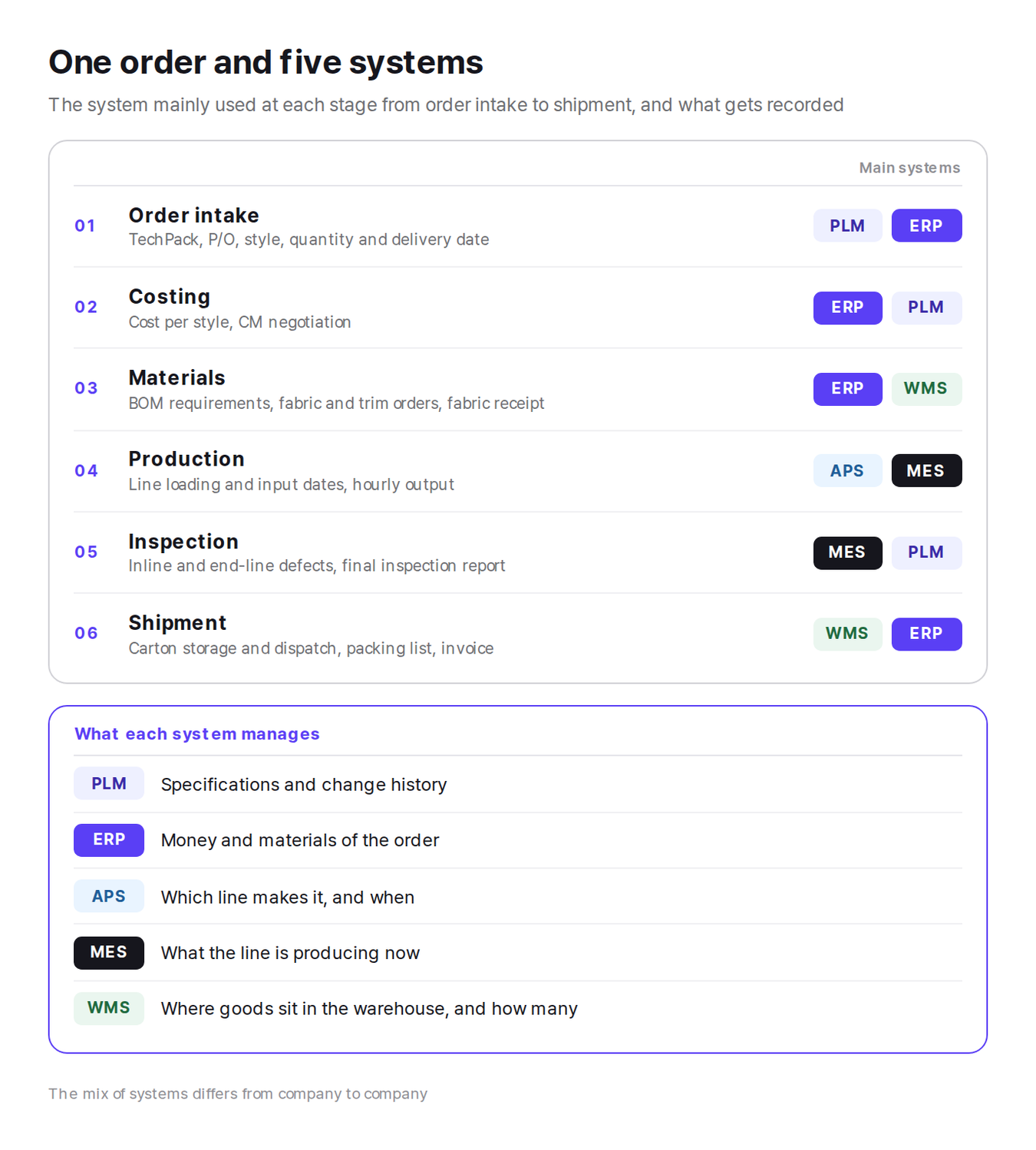
Now let’s place the five systems on the flow of a single order. An order goes through six stages: order intake, costing, materials, production, inspection and shipment.
| Order stage | Main systems | Main companies |
|---|---|---|
| Order intake | PLM, ERP | Buyer, vendor |
| Costing | ERP, PLM | Vendor, factory |
| Materials | ERP, WMS | Vendor, factory |
| Production | APS, MES | Factory |
| Inspection | MES, PLM | Factory, vendor, buyer |
| Shipment | WMS, ERP | Factory, vendor |
The six stages of an order and the systems mainly used at each (the mix differs by company)
The right-hand column shows what is particular about apparel orders. The five systems are not gathered in one company. They are split across three companies: the buyer, the vendor and the factory. PLM often sits with the buyer, ERP at the vendor’s head office, and APS, MES and WMS at the factory, and the three companies are usually in different countries.
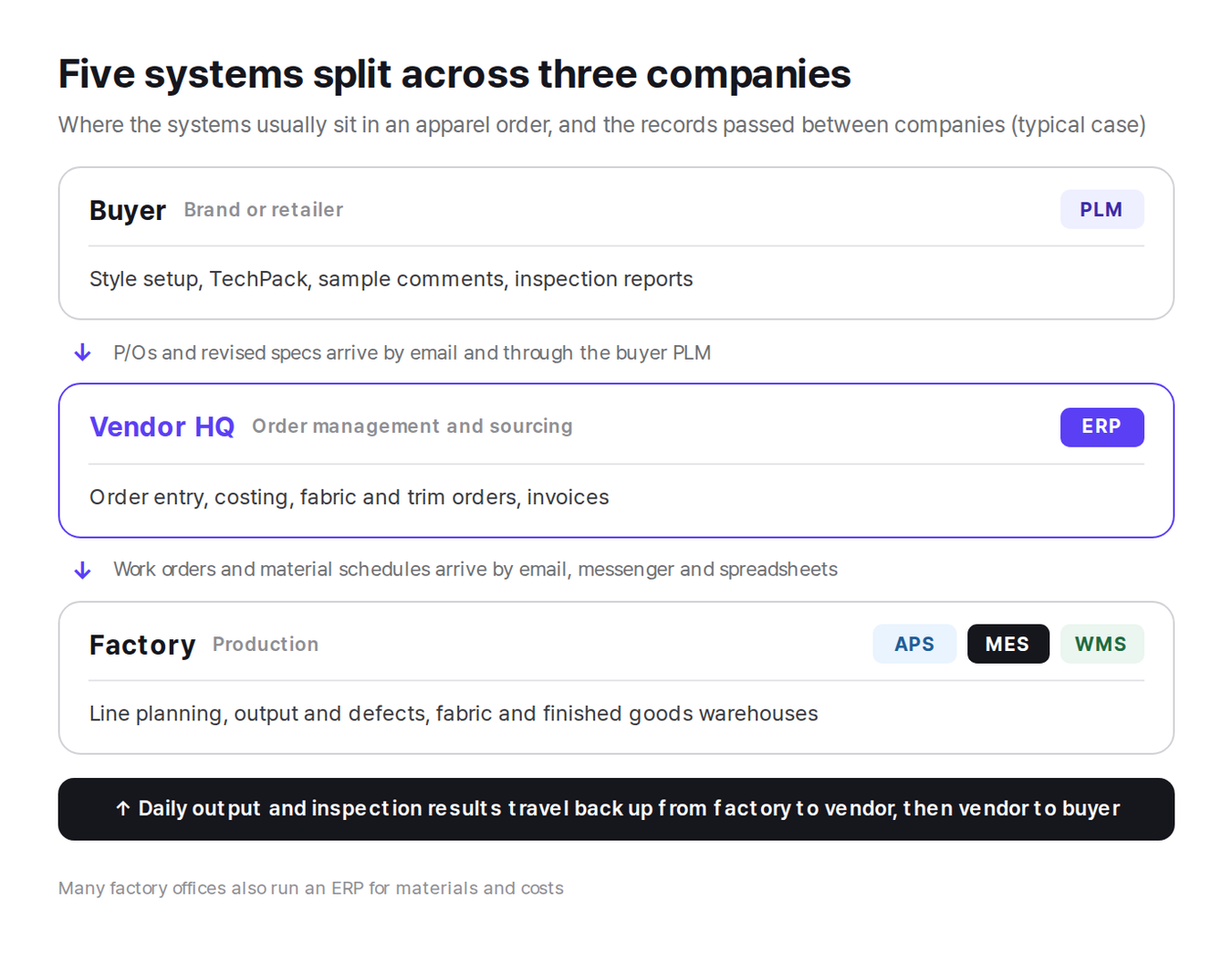
That is why, in apparel orders, information breaks off more often between systems, meaning between one company and the next, than inside any one system. A revised specification in the buyer’s PLM does not make it into the BOM in the vendor’s ERP, or the output recorded in the factory’s MES reaches the vendor by email the next day. How the three companies divide one order between them is covered in How Apparel Orders Are Split Between Knowledge Services and Manufacturing.
Wrapping up
ERP, MES, PLM, WMS and APS are all names given according to which part of a company’s work each system takes on. Rather than memorizing the names, check one by one where your company writes down garment specifications, where costing and purchasing are done, who builds the line plan and how, when and to whom today’s output is reported, and how fabric rolls are found. That shows which systems you already have and which work still lives in spreadsheets and on paper.
In the next post I will look at why these systems came into being as five separate systems: the history that runs from MRP to ERP, and the separate histories of PLM, MES, WMS and APS that grew up alongside it. Part 3 will follow one apparel order through the systems of three companies to see where it breaks off, and part 4 will explain why SIJE brought these functions together into one piece of software.
Related reading
- Why the Same Order Number Is Entered Again and Again Until Shipment
- How Apparel Orders Are Split Between Knowledge Services and Manufacturing
- Why Production Data Measured on the Floor Gets Lost
- How Clothes Are Made: From Yarn to the Buyer’s Warehouse
References
- SAP, What is product lifecycle management (PLM)?. Definition of PLM and the data it manages (BOM, engineering changes, CAD). ↩
- Lectra, What is fashion PLM?. Functions of fashion PLM and the teams that use it. ↩
- Gartner, Glossary: Enterprise Resource Planning (ERP). Definition of ERP and its common process and data model. ↩
- NetSuite, The History of ERP. The first MRP system in the early 1960s, and Gartner naming ERP around 1990. ↩
- Simio, What is Advanced Planning and Scheduling (APS)?. Definition of APS as planning that considers limited material and finite capacity at the same time. ↩
- PlanetTogether, The Difference Between Finite Capacity Scheduling and Infinite Capacity Loading. Difference between infinite capacity loading and finite capacity scheduling. ↩
- SAP, What is a manufacturing execution system (MES)?. Definition of MES and how its role differs from ERP. ↩
- ISA, ISA-95 Standard: Enterprise-Control System Integration. The five-level hierarchy and the interface between Levels 3 and 4. ↩
- AltexSoft, Warehouse Management Systems: Key Processes, Features, and WMS Types. Definition of WMS and core warehouse processes. ↩
- CSCMP, SCM Definitions and Glossary of Terms. Definition of supply chain management. ↩
