


Smart factories for small sewing factories 1/3 · (1) Why Smart Factory Systems Did Not Fit Small Sewing Factories · (2) One Tablet per Sewing Cell · (3) How a Small Sewing Factory Adopts a Smart Factory Through a Government Support Program
KEY POINTS
Small sewing factories were left out of smart factory projects because of how they run, more than because of their size. Styles change every day or two and several styles run on one line at the same time, so the equipment and control standards built for mass production lines, where one style runs for a long time, do not carry over as they are. In 2025 SIJE ran a five-week PoC at a shirt sewing factory in Korea with 20-some operators and confirmed a measurement accuracy of 94.70~100% by operation. The same PoC also showed that a small factory cannot easily handle many types of equipment.
The deployment cases SIJE has covered on this blog so far were mostly large factories overseas. This series covers a factory in Korea with 20-some operators. Part 1 explains why the existing approach did not fit small sewing factories, Part 2 how we changed the design for a small line, and Part 3 the steps for adopting a smart factory through a government support program.
The factory in this series is a sewing factory in Korea whose main product is shirts. It has 20-some operators and makes premium garments for the domestic market in small lots of many styles.1
The one-day gap between office numbers and the floor
This factory had an ERP in the office. Output, quality and material flow on the sewing line, however, were managed with operators’ daily reports and manual Excel tallies. The daily reports written on the floor were keyed into the system at the office once a day, so the numbers the office saw were at least a day behind what had actually happened on the floor.1
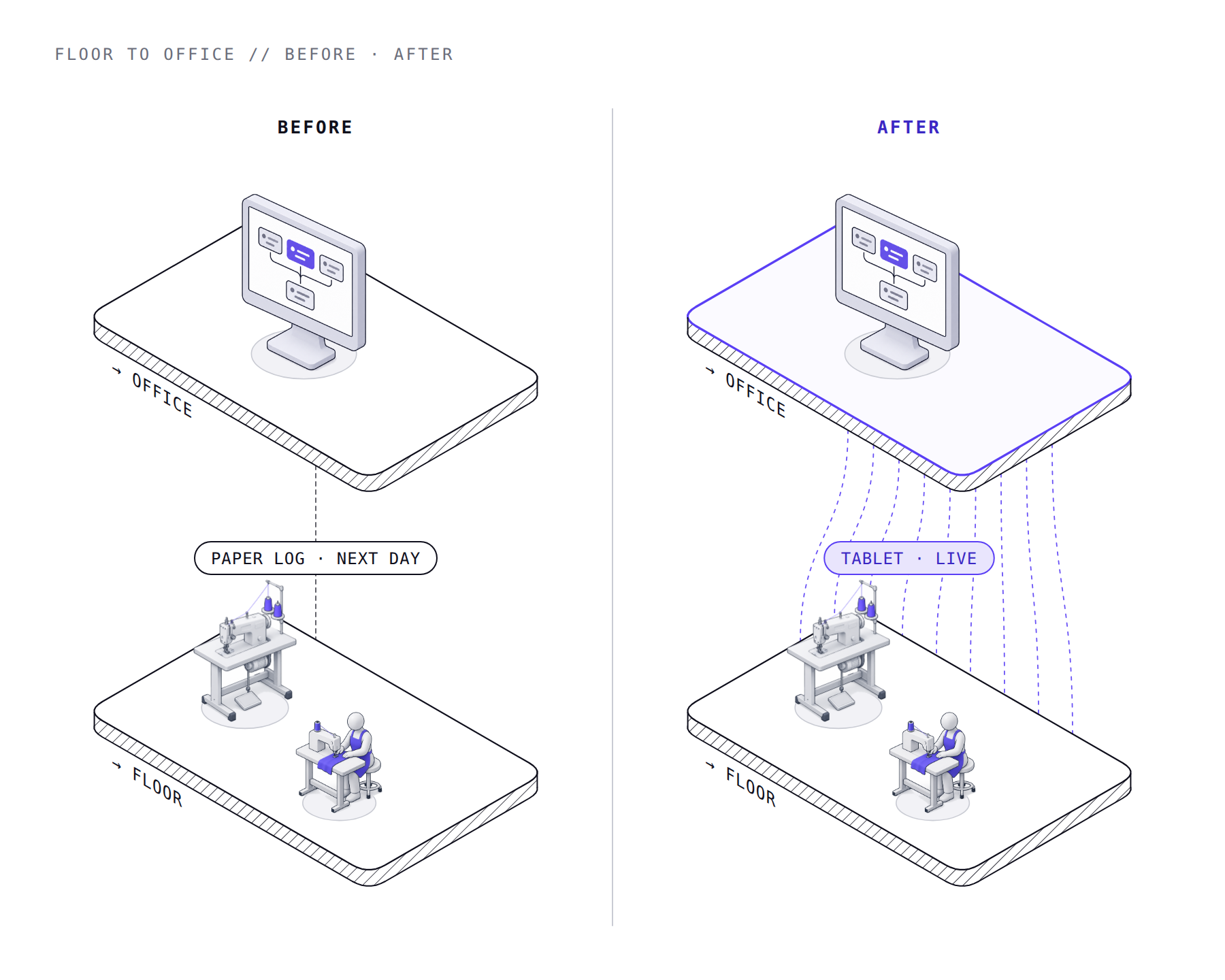
When a bottleneck forms in the morning, the office finds out the next day. By then production of that style is already winding down. How often a bottleneck repeats at which operation is never recorded as a number, so line assignment is left to the supervisor’s experience.
Why the mass production approach does not fit
The equipment and control standards SIJE had installed at large factories were built for mass production lines that run one style for a long time. A small sewing factory differs on three points.
First, styles change often. The changeover cycle we confirmed at this factory during the PoC was 1~2 days.2 When a new style comes in, operators are slow until their hands learn it, and by the time they have, the line moves to the next style. We covered this in Why the First Week Loses Money: Putting the Learning Curve into the Quote. The order ends before reference times can build up, so the method of sampling for several days to set a standard cannot be used.
Second, several styles run on one line. On a mass production line one style is loaded on one line. This factory runs several styles on a single line at the same time.2 A line-level target such as “this line makes this many pieces today” is not enough to manage it, and separate standards by style and by operation are needed.
Third, there is nobody assigned to look after the equipment. More types of equipment mean more installation and inspection work, and a small factory can hardly keep a person dedicated to it. In this factory’s build plan, operating staff was the item rated as the biggest risk.3
| Item | Mass production line | Small line |
|---|---|---|
| Style changeover | One style runs for a long time | Every 1~2 days |
| Line operation | One style per line | Several styles on one line |
| Standard needed | Line-level target | Standards by style and by operation |
| Equipment care | Dedicated staff | Hard to keep dedicated staff |
How conditions differ between a mass production line and a small line
What the five-week PoC confirmed
SIJE ran a PoC at this factory for five weeks in 2025. We attached 14 smart counters, 14 andon lamps and 14 pressure pads to the sewing machines. The setup senses pedal pressure and vibration and counts output automatically.2
| Item | Result |
|---|---|
| Period | 5 weeks in 2025 |
| Data collected | 124,992 counts |
| Output tallied | 12,072 pcs |
| Measurement accuracy | 94.70~100% by operation |
| Operation | No downtime for 5 weeks |
Results of the five-week PoC2
Accuracy is the quantity counted by the equipment compared, operation by operation, with the quantity counted by hand. The PoC process and the reaction on the floor are written up in Monolog PoC (2) : Smart Factory Innovation in Apparel Manufacturing.
Two results mattered more than the volume of data. First, operation-level time tables were built for 7 styles.2 Even on a line where the style changes every 1~2 days, standards by style and by operation build up when measurement is continuous. Second, we confirmed that productivity and skill can be assessed per operator on a weekly basis. Line assignment that used to rest on the line leader’s feel can now be backed with numbers.
What the PoC left open
The PoC confirmed what was possible and also what still had to be solved.
There were three types of equipment. Each sewing cell needed a counter, an andon lamp and a pressure pad fitted separately. That was manageable at 14 units, but across a whole line the installation and upkeep become a burden for a small factory.4
Only quantity could be counted. A counter reports that one piece is finished and nothing more. It cannot separate how much of the time for that piece was actual sewing and how much was picking up fabric or waiting.
For the next stage we therefore changed the design to one type of equipment that reads working motion as well as quantity. Part 2 continues from here.
Wrapping up
Smart factory systems did not fit small sewing factories for three reasons: styles change often, several styles run on one line, and nobody is assigned to the equipment. The five-week PoC confirmed that standards still build up under these conditions when measurement is continuous. It also left the task of making the equipment simpler.
Sewing production glossary
- Changeover: switching the line from the style it was making to the next one. Machine settings and work assignments have to be set again.
- Operator daily report: a daily record in which operators write down the quantity they made and the work they did.
- Andon: an indicator lamp that shows the status of the line by color.
- Bottleneck: an operation that processes more slowly than the ones before and after it, so work in process piles up.
- PoC (Proof of Concept): applying a new method on a small scale at a real site to confirm that it can work.
👉 One Tablet per Sewing Cell: Data Collection Designed for a Small Line
👉 How a Small Sewing Factory Adopts a Smart Factory Through a Government Support Program
References
- SIJE internal material, build project summary. Production type and size of the adopting factory, and how floor records were kept before the build. ↩
- SIJE internal material, results of the 2025 in-house PoC. PoC period, installed equipment, data volume, measurement accuracy by operation, changeover cycle and line operation, and operation-level time tables for 7 styles. ↩
- SIJE internal material, risk register of the build project. Operating staff item. ↩
- SIJE internal material, reasons for changing the collection equipment between the PoC and the main build. ↩
