


What the New sije.io Shows About SIJE’s Direction: From Digital Transformation to Manufacturing Knowledge as an Asset
KEY POINTS
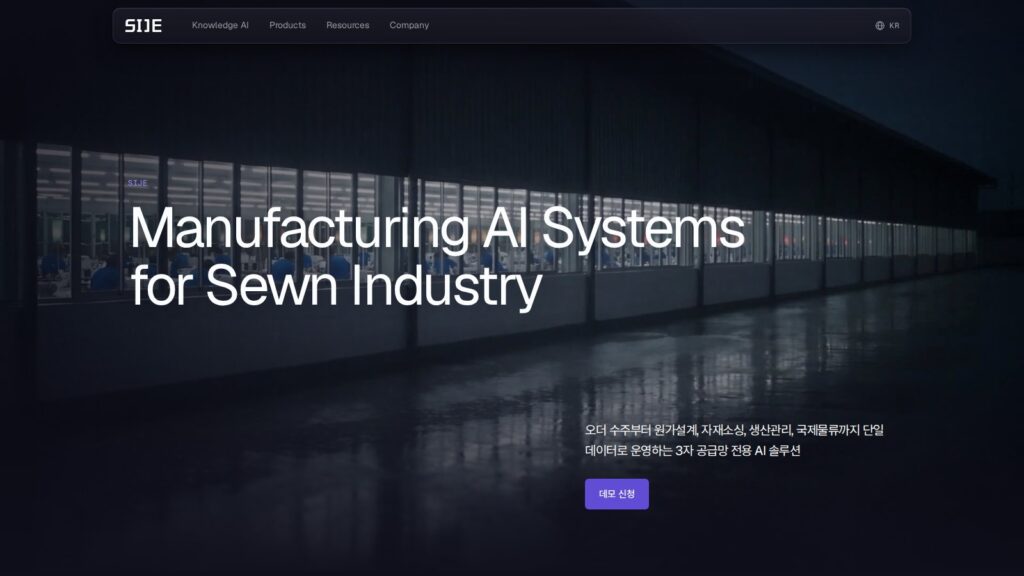
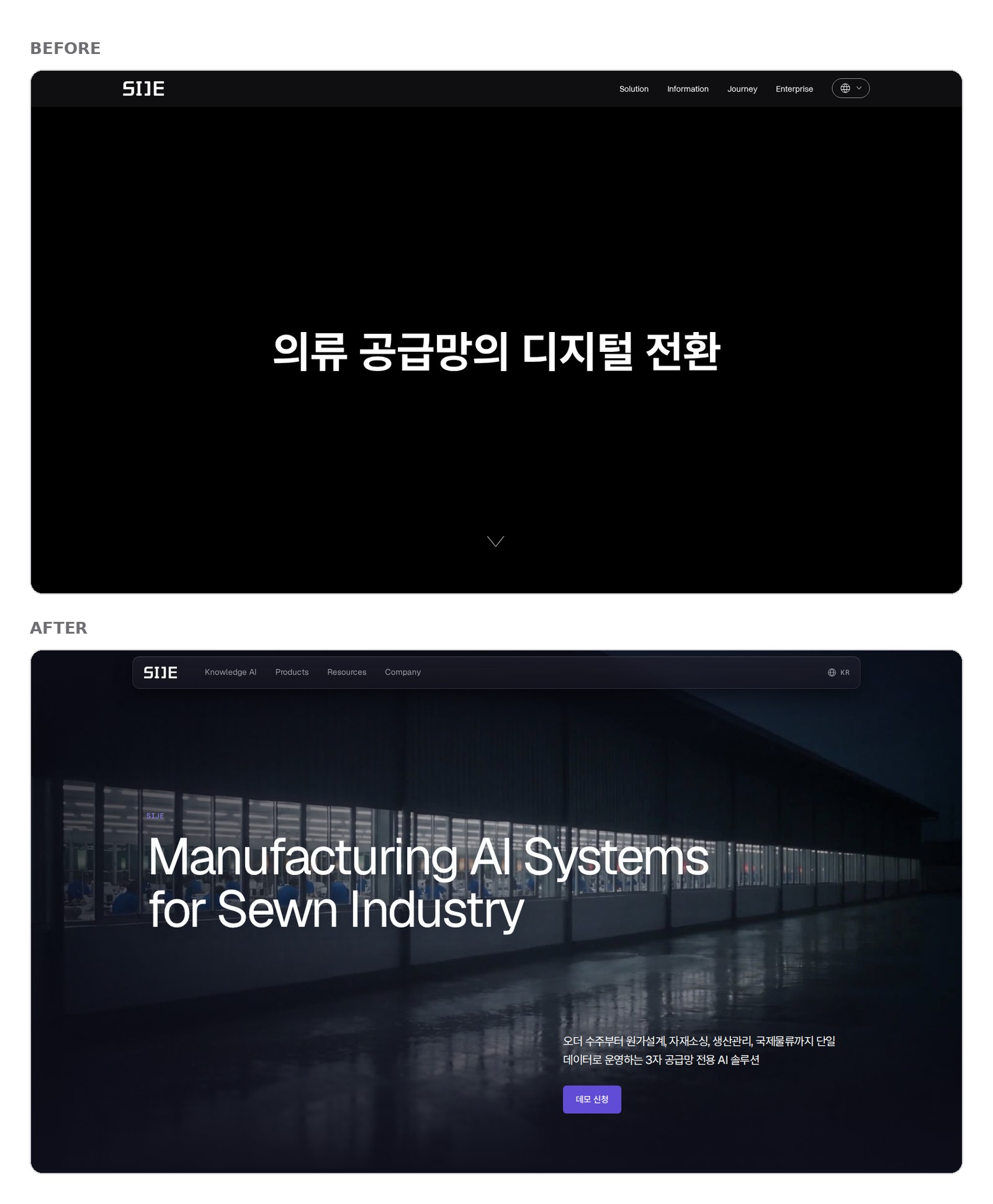
SIJE has rebuilt its company website, sije.io. The previous site led with “Digitalizing Apparel Supply Chain” and introduced two products, Monolis and Monolog. The new site puts manufacturing knowledge as an asset at the center, explains the 3-party trade structure and the CM problem first, and then shows three products. The target has widened from apparel to the sewn products industry as a whole, and the track record is presented as the scale of accumulated data, certificate numbers and a patent list.
A website is the shortest document that shows how a company explains its own work. The previous sije.io was built when SIJE had two products. Since then the product line grew and the scope of application widened, and the site’s explanation no longer matched what the company actually does. This post puts the previous site and the new site side by side and goes through five things that changed.
| Item | Previous site | New site |
|---|---|---|
| First-screen headline | Digitalizing Apparel Supply Chain | Manufacturing AI Systems for Sewn Industry |
| Core concept | Digital twin, smart factory | Manufacturing knowledge as an asset |
| First menu | Solution | Knowledge AI |
| Target industry | Apparel | Apparel, plush toys, bags, footwear, soft goods |
| Products | Monolis, Monolog | Monolis, Monolog, Mono:parts |
The previous site and the new site compared12
1. The words that describe the company
The first-screen headline of the previous site was “Digitalizing Apparel Supply Chain”. Below it came AI digital twin technology and the smart factory, and the business fields in the company profile were listed as Smart Factory, AI and Metaverse.1
The first-screen headline of the new site is “Manufacturing AI Systems for Sewn Industry”, described as “AI for the 3-party supply chain”. The concept at the center is manufacturing knowledge as an asset.2
Manufacturing knowledge as an asset means capturing operation know-how that lived only in veterans’ experience and handwritten notes as sewing-machine measurements, standardizing it with a sewing-specific data dictionary, and building it up so that AI can use it to reason. The new site shows this process in six stages.
| Stage | Name | What it does |
|---|---|---|
| 1 | Capture Source Data | Sewing-machine signals measure the actual time of each operation |
| 2 | Give Data Meaning | Operation names that differ by factory are mapped to 47,359 standard operations |
| 3 | Build Single Master Data | Measurements are filtered and fixed as company-wide master data |
| 4 | Pre-Costing Design | Costs are designed before the order is taken, on confirmed master data |
| 5 | PQCD Collaboration | Buyer, vendor and factory align delivery and cost on the same reference table |
| 6 | Full Supply Chain Integration | The same standard carries across orders, entities and seasons |
Six stages to a manufacturing knowledge asset2
Digital transformation refers to the process of moving work done on paper and in Excel into a system. Manufacturing knowledge as an asset also covers what stays with the company after that move. Measured time per operation, difficulty per style, machine and staffing results, and the history of problems and actions remain as company records even when the person in charge changes.
2. The structure of the problem comes before the products
The menu of the previous site was Solution, Information, Journey and Enterprise. The menu of the new site is Knowledge AI, Products, Resources and Company.
The biggest difference is that the first menu changed from Solution to Knowledge AI. Solution was a product introduction. Knowledge AI explains, before any product appears, why an apparel order is hard, in five parts.2
- 3-party trade: ordering, sourcing and production sit in different countries
- Order lifecycle: one order passes six stages from intake to shipment, and the same values are retyped into each tool
- Production data: sampled values from a few stopwatch cycles stand in for the whole standard
- Pre-costing design: vendor margin and factory profitability are both set by one number, CM
- Knowledge as an asset: operation knowledge that scattered when an order closed is built up as the basis for the next order
We changed the order because the previous structure could not explain why SIJE builds both office software and floor measurement equipment. The answer is in CM. CM is a cost item for the vendor and the entire revenue for the factory. To set this value accurately, the order records in the vendor’s office and the measured time on the factory floor have to be connected as the same data. We covered this structure in Why Vendor and Factory Calculate the Same CM in Opposite Directions.
3. From apparel to the sewn products industry
The previous site named its target as the apparel industry, and described the supply chain as brands, apparel vendors and factories.1
The new site names its target as “any industry where the feel of human hands decides product quality”. The first screen places five industries side by side: apparel, plush toys, bags, footwear and soft goods.2
The basis for widening the target is that the operations and the trade structure are the same. All five make products by joining fabric on sewing machines, and ordering, sourcing and production are split among different organizations. The approach of measuring operation time, turning it into master data and designing cost on that value applies as it is. This is also why the headline of the new company page is “3-Party Trade, Rebuilt in Software”.
4. From two products to three
| Product | Description on the previous site | Description on the new site |
|---|---|---|
| Monolis | SaaS-based PLM solution Four areas: Analysis, Merchandising, Planning, Production | Software unifying supply chain records into one record per order Nine steps from P/O receipt to post-cost settlement |
| Monolog | IoT solution for big data Production traffic lights and real-time achievement monitoring | A measurement and forecasting solution that measures production time and shows line status and forecasts Two builds: device and tablet |
| Mono:parts | Not listed | A trims sourcing solution that manages trims as an item-level library and connects ordering, shipment and settlement |
Product descriptions compared12
For Monolis, the way it is explained changed from a feature list to an order flow. The new site lines up P/O receipt, operations and CM, pre-costing, materials and trims POs, line assignment, production results, warehousing and shipment, and post-cost settlement, and shows that the value from one step becomes the input of the next.
For Monolog, the scope widened from monitoring to forecasting. The previous site introduced production traffic lights that show operator productivity and an achievement screen. The new site introduces three stages: showing line status from measured data, forecasting output, and suggesting staff reallocation. There are now two builds as well. Mass production lines use the device, and high-mix low-volume lines use the tablet. The tablet build is written up in One Tablet per Sewing Cell: Data Collection Designed for a Small Line.
Mono:parts is a newly added product. Trim requests that used to be raised style by style are grouped by item and ordered together. Repetitive entries such as registering PO files, filling in purchase prices and entering shipping documents are filled in by AI, and staff check the values before saving. It starts with issued accounts, with no build project.
The explanation of how adoption works changed too. The previous site introduced consulting as a separate business item. The new site introduces diagnosis and design as the first of three rollout phases, followed by build and go-live, then operation.
5. How the track record is shown
The previous site showed its track record through the productivity gain of a PoC case and a list of awards.1
The Resources page of the new site puts the scale of accumulated data first.2
| Item | Scale |
|---|---|
| Operation data | 1,021,940 rows |
| Operation dictionary | 47,359 types |
| Styles with final SMV | 5,019 types |
| Learning curve data | 56 factories |
Indicators on the Resources page of the new site2
The Company page lists certifications with their numbers and scope wording as issued, and patents as a list. We took the view that a company talking about manufacturing knowledge as an asset should put its own accumulated asset forward in numbers first.
Wrapping up
The new site introduces SIJE as a company that builds the operation knowledge of the sewn products industry into a data asset and designs cost and production on that asset. Compared with the previous site, which introduced two products for digitalizing the apparel supply chain, the menu order, target industries, product lineup and the way results are shown have all changed to fit this direction. The new site is at sije.io.
Glossary
- 3-party trade: a trade structure in which the buyer who orders, the vendor who handles sourcing and the factory that produces are in different countries.
- CM (Cut & Make): the processing fee a factory receives for making the garment.
- Pre-costing: the cost calculated in advance, before the order is taken.
- Master data: information the whole company refers to with the same value, such as operation names and standard times.
- SMV (Standard Minute Value): the standard time it takes to finish one operation.
👉 How Measured Values Become a Company Asset
👉 How Apparel Orders Are Split Between Knowledge Services and Manufacturing
References
- SIJE, previous sije.io (before the October 2026 redesign). Wording and menu structure of the first screen, Solution (Monolis, Monolog), About and Journey pages. ↩
- SIJE, new sije.io Wording and indicators on the Home, Knowledge AI, Products, product detail (Monolis, Monolog, Mono:parts), Company and Resources pages. ↩
